- Mar 21, 2026
-
Land Investment in Tamil Nadu 2026 — Where to Buy, What to Check, and What to Avoid
Published by Daga Developers | March 2026 | 10 min read
Tamil Nadu is one of the most consistent real estate markets in India. It does not spike wildly like Hyderabad or Gurugram, and it does not stagnate like parts of central India. It grows — steadily, year after year — driven by a diversified economy, strong infrastructure investment, a skilled workforce, and a state government that has been relentlessly building roads, highways, metro lines, and industrial corridors for two decades.
But steady does not mean simple. Tamil Nadu has over 38 districts, thousands of layouts, and an enormous range of price points, legal frameworks, and risk profiles. Buying the wrong land — in the wrong location, from the wrong seller, without the right documents — can turn a smart investment into a legal nightmare.
This guide is for anyone seriously considering land investment in Tamil Nadu in 2026 — whether you are a resident investor, a first-time buyer, or an NRI looking to invest back home. We will cover where to look, what the market is doing, the legal non-negotiables, the mistakes to avoid, and the one emerging location that most investors from Chennai and Bengaluru are seriously underestimating.
The State of Tamil Nadu Real Estate in 2026 — What the Numbers Tell Us
The data from 2025 into 2026 tells a clear story:
Tamil Nadu's tier-2 cities saw homes worth over ₹40,000 crore sold in just the first quarter of 2025 — a 6% rise year-on-year. Land transactions across the state covered approximately 2,900 acres worth ₹31,000 crore, signalling that land — not apartments — is where serious investors are putting their money.
Property prices across key tier-2 cities rose between 14% and 47% within a single year. Rental yields are healthy at 6–9% for residential properties and even higher for industrial and warehouse-adjacent land near key corridors.
The January 2026 guideline value revision by the Tamil Nadu Registration Department increased values in Chennai's suburban zones (OMR, ECR, GST Road) and in tier-2 hubs like Madurai and Coimbatore — a direct signal from the government that land values in these corridors are being officially recognised as higher.
What does this mean for a buyer in 2026?
It means that Tamil Nadu land is not cheap anymore in the traditionally popular zones — and anyone waiting for prices to come back down is going to wait a long time. The smarter play is identifying where the next wave of appreciation is building before the crowd arrives.
The 5 Types of Land Investment in Tamil Nadu — Know What You Are Buying
Not all land in Tamil Nadu is the same, legally or commercially. Before you look at any specific location, understand which category of land you are buying.
1. DTCP Approved Residential Layout Plots The safest and most liquid form of land investment. The Directorate of Town and Country Planning (DTCP) has verified the land use, approved the layout, and sanctioned it for residential development. Banks will finance it. Resale is straightforward. This is what you should be buying if your goal is a home, a retreat, or a medium to long-term investment.
2. CMDA Approved Plots (Chennai Metropolitan Area) Within the Chennai Metropolitan Development Authority's jurisdiction, CMDA approval is the equivalent of DTCP. If you are buying in Chennai or its extended suburbs, look for CMDA approval.
3. Panchayat Approved Plots These are layouts approved at the local panchayat level rather than at the DTCP level. They are legal within certain limits but carry more risk — they are harder to finance through banks, have less standardised infrastructure, and can be more complicated at resale. Approach with caution and always get independent legal advice.
4. Agricultural Land (Farmland) Agricultural land in Tamil Nadu can only be purchased by farmers or those classified as agriculturalists under state law. Non-agriculturalists buying agricultural land face serious legal complications. However, agricultural land that has been converted (land use change obtained) for residential or commercial purposes can be purchased freely. Always verify conversion status before buying any farmland for investment.
5. Unapproved Open Plots These are individual plots sold by landowners without any formal layout approval. They are almost always the cheapest option — and for good reason. No bank will finance them, resale is extremely difficult, and you take on all legal liability personally. Avoid these for investment purposes unless you have deep local knowledge and an excellent lawyer.
Where to Invest in Tamil Nadu in 2026 — Location by Location
Here is an honest, data-backed breakdown of Tamil Nadu's key real estate zones and what they offer investors in 2026.
Chennai and Suburbs — High Price, Established Growth
Chennai remains Tamil Nadu's most mature real estate market. Property prices have risen 16% year-on-year in 2024 with some micro-markets in Teynampet, Minjur, and Vellanur seeing 100%+ appreciation over three years.
The best suburban zones for plot investment in 2026:
OMR (Old Mahabalipuram Road): India's largest IT corridor outside Bengaluru. High rental demand, strong NRI interest. Entry prices have risen sharply — affordable pockets are now limited to Kelambakkam and beyond the toll plaza.
GST Road corridor: Connects Chennai to the south. Benefits from Oragadam's industrial cluster (Tamil Nadu's largest), airport adjacency, and strong job creation. Sriperumbudur and Irungattukottai offer plots at relatively accessible prices.
ECR (East Coast Road): A lifestyle and second-home corridor. Premium pricing. Suitable for buyers who want a beach-adjacent investment or a second home rather than a pure investment play.
Poonamallee–Sriperumbudur belt: West Chennai's fastest-growing corridor. Metro Phase 2 connectivity, industrial investment, and relative affordability make this a strong pick for 5–10 year investment horizons.
Reality check: Chennai plots near established job corridors now start at ₹3,500–₹5,000 per sq ft at the affordable end and go well above ₹8,000 per sq ft in premium zones. The large-gain window in Chennai's suburbs has largely closed. Buyers entering now are paying for established demand, not emerging opportunity.
Coimbatore — Tamil Nadu's Second Engine
Coimbatore is the standout tier-2 performer. Home sales grew 21% year-on-year — the highest among Indian tier-2 cities. Key areas like Saravanampatti, Kovaipudur, and Kalapatti are appreciating due to metro connectivity proposals, logistics growth, and strong industrial and educational demand.
Average rates: ₹5,800 to ₹6,350 per sq ft in established zones. Peripheral areas offer entry at significantly lower prices.
Best for: Buyers who want a city with real economic fundamentals, not just infrastructure promises.
Madurai, Trichy, and Salem — The Emerging Belt
These three cities are at different stages of the same growth story — improving infrastructure, expanding hospitals and educational institutions, government investment, and rising residential demand from a growing middle class.
Madurai's international airport and upcoming Madurai Metro are catalysts. Trichy's strategic location between Chennai, Madurai, and Coimbatore makes it a connectivity hub. Salem benefits from the Salem–Chennai Green Corridor (expressway) which has dramatically shortened travel times.
Average prices in residential plot zones: ₹1,200–₹3,500 per sq ft depending on location within each city.
Best for: Long-term investors with a 7–10 year horizon who want to buy ahead of infrastructure completion.
Tiruvannamalai — The Market Most Investors Have Not Properly Priced
This is the section most Tamil Nadu land investment guides skip entirely — because Tiruvannamalai does not fit the conventional "industrial growth + job creation" investment thesis that analysts use for every other city.
Tiruvannamalai's growth driver is entirely different, and that is precisely why it is underpriced relative to what it offers.
The town sits at the base of Arunachala Hill — one of the most sacred sites in South India, drawing pilgrims, spiritual seekers, international visitors, retirees, digital nomads, and NRIs from Australia, Canada, the USA, and Singapore consistently throughout the year. Demand here is not seasonal. It is structural, growing, and driven by a global audience.
The numbers: Land near Sri Ramanashramam and the Girivalam path has appreciated over 40% in the last five years. With ring road development, highway improvements, and the town's growing infrastructure, that appreciation story has years left to run.
What makes Tiruvannamalai particularly interesting for investors in 2026 is the price arbitrage that still exists. You can buy a DTCP and RERA approved gated community plot with full amenities — 1.4 km from Sri Ramanashramam, with an unobstructed Arunachala Hill view — at a fraction of what comparable quality land costs in Chennai's suburbs or Coimbatore's growth corridors.
That gap is narrowing. It is not yet closed.
For buyers who missed the Chennai suburban wave, or who want diversification beyond the conventional tier-2 cities, Tiruvannamalai deserves serious attention.
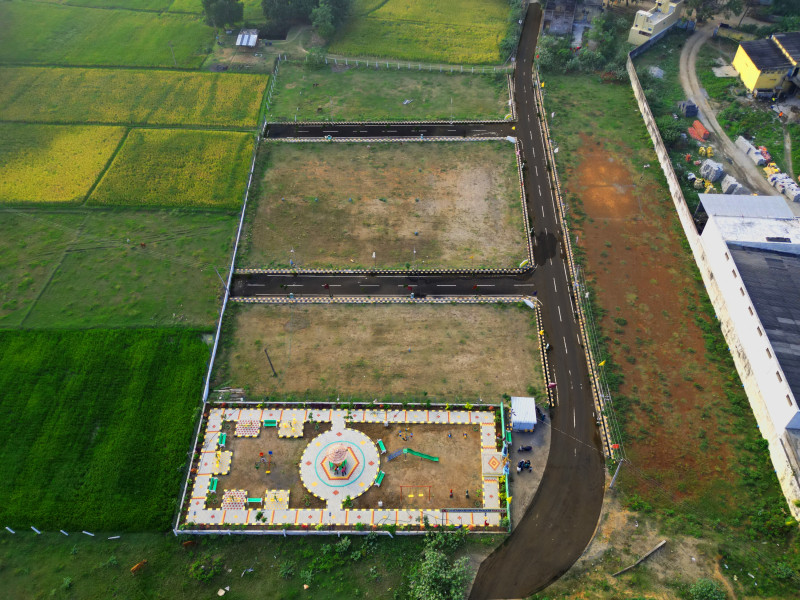
Currently Available: Swarna Boomi Elite — 89 plots remaining near Ramanashramam, with Arunachala Hill view, DTCP and RERA approved, bank loan eligible. View project details and layout map →
The Legal Checklist — What to Verify Before Signing Anything
Regardless of where in Tamil Nadu you buy, these are the documents and verifications you cannot skip.
Patta and Chitta The patta is Tamil Nadu's primary land ownership record maintained by the Revenue Department. The chitta is the linked document showing classification (wet land, dry land) and area. Both must be in the seller's name. Verify these independently at the local Tahsildar office or through the Tamil Nilam portal online.
Encumbrance Certificate (EC) The EC records all registered transactions on a property — sales, mortgages, gifts, court orders. Get the EC for a minimum of 13 years and ideally 30 years. Available through TNREGINET. Any unexplained gap in transactions is a red flag.
DTCP or CMDA Layout Approval Get the approval number and verify it independently. The approval document should match the physical layout boundaries. Ensure that your specific plot falls within the approved layout, not outside it.
RERA Registration For projects with more than 500 sq metres of development or more than 8 apartments/plots, RERA registration is mandatory. Verify the RERA number on the Tamil Nadu RERA portal.
Parent Document Chain Ask to see the full chain of ownership from the original patta holder to the current seller. Every transfer should have a corresponding registered sale deed. A break in this chain requires explanation and independent legal opinion.
FMB Sketch The Field Measurement Book (FMB) sketch shows the exact boundaries of the plot as recorded by the Survey Department. Match this against the physical boundaries of the plot you are being shown.
Land Use Classification Ensure the land is classified for residential use, not agricultural or industrial. Agricultural land conversion requires a specific land use change order from the Collector's office.
Tax Receipts Current property tax paid receipts confirm the owner is maintaining the property in their name and that no dues are outstanding to the local body.
Further Reading: How to Verify DTCP Approved Plots in Tamil Nadu →
The 6 Mistakes Tamil Nadu Land Buyers Make — and How to Avoid Them
Mistake 1: Buying because the price is low Cheap land is usually cheap for a reason — unapproved layout, disputed title, wrong land use classification, or a location with no appreciation potential. Always ask why the price is lower than comparable plots nearby.
Mistake 2: Not visiting the site Brochures and Google Maps are not substitutes for standing on the land. Visit the site. Walk the roads. Check whether the infrastructure shown in the render actually exists on the ground.
Mistake 3: Paying the full amount before registration Never pay 100% of the consideration before the sale deed is registered in your name at the Sub-Registrar's office. Agree on a payment structure — typically 10–20% advance, balance at registration.
Mistake 4: Ignoring the developer's track record A developer who delivered three projects cleanly is a very different proposition from one who is developing their first layout. Ask for references. Visit a completed project. Talk to existing plot owners if possible.
Mistake 5: Not understanding guideline value Guideline value determines the minimum stamp duty and registration charges you pay, regardless of the actual sale price. A property sold for ₹30 lakhs in an area with a ₹40 lakh guideline value means you pay stamp duty on ₹40 lakhs. Factor this into your total acquisition cost.
Further Reading: How to Find Market Value of Land in Tamil Nadu →
Mistake 6: Buying without a lawyer's opinion A registered advocate's legal opinion on the title typically costs ₹5,000–₹15,000. It can save you from a property dispute worth lakhs. This is not an optional expense. Make it non-negotiable before any purchase.
A Special Note for NRI Investors
Tamil Nadu is one of the top destinations for NRI real estate investment in India, and for good reason — the state has a large diaspora, strong cultural ties, and a legal framework that is relatively straightforward for NRI purchases.
Key points for NRI buyers:
Eligibility: NRIs and OCIs can purchase residential and commercial property in India freely. Agricultural land is a separate matter — non-resident Indians cannot buy agricultural land without specific approval.
Repatriation: Sale proceeds from NRI property purchases can be repatriated subject to RBI guidelines, provided the purchase was made through normal banking channels.
Power of Attorney: If you cannot be physically present for registration, a registered Power of Attorney in favour of a trusted family member or representative allows them to complete the transaction on your behalf.
Tax implications: NRIs are subject to TDS (Tax Deducted at Source) on property purchases in India. The buyer is typically responsible for deducting and depositing the TDS. Consult a chartered accountant for current rates.
Virtual due diligence: Reputable developers now offer video walkthroughs, digital document verification, and WhatsApp-based consultations for NRI buyers who cannot visit in person.
Many NRI buyers from Australia, Canada, Singapore, and the USA who were considering Tiruvannamalai as a spiritual investment have found Swarna Boomi Elite to be a natural fit — proximity to Ramanashramam, full legal approvals, and a developer with 28 years of clean track record. Reach our team on WhatsApp for NRI-specific guidance →
How to Think About Tamil Nadu Land Investment in 2026 — A Framework
Before closing, here is a simple decision framework for any Tamil Nadu land investment:
Step 1 — Define your purpose. Are you building a home in the next 2 years? Holding for 7–10 years? Seeking rental income? Your purpose determines your location, price point, and risk tolerance.
Step 2 — Match location to purpose. Chennai suburbs for near-term rental yield and liquidity. Coimbatore and emerging cities for medium-term growth. Tiruvannamalai and spiritual corridors for long-term appreciation with emotional value. Highway plots for affordable entry with 10-year upside.
Step 3 — Verify before you pay anything. EC, patta, DTCP/CMDA approval, parent documents, FMB sketch, RERA number. All of these. No exceptions.
Step 4 — Choose the developer as carefully as the location. In Tamil Nadu's real estate market, the developer's track record matters enormously. Look for years of operation, number of completed projects, and buyer references.
Step 5 — Visit the site. No matter how good the brochure looks.
About Daga Developers
Daga Developers has been building DTCP and RERA approved residential layouts in Tiruvannamalai since 1996 — 28 years, 20+ completed projects, and over 2,000 plots delivered to buyers from across India and around the world.
If Tiruvannamalai is part of your Tamil Nadu investment consideration, we would be glad to walk you through what is available, show you the sites in person, and guide you through the complete documentation process.
📞 Call: +91 72002 22263 | +91 78882 22263 📲 WhatsApp: Chat directly → 🌐 View all projects:dagadevelopers.com/projects
Related Reading: Gated Community Plots in Tiruvannamalai — Complete Buyer's Guide 2026 → Plots Near Ramanashramam — Everything You Need to Know →

Comments :
Currently, there are no comments in this post. Be the first person to comment on this post.