- Jul 05, 2024
-
The Girivalam Path in Tiruvannamalai – Distance, Temples, Ashta Lingams & Complete Guide
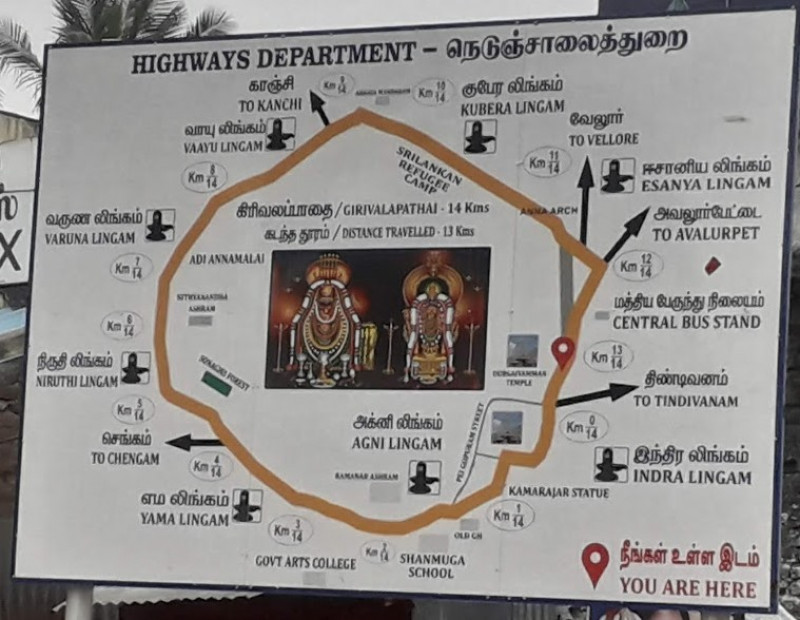
The Girivalam Path in Tiruvannamalai is one of the most sacred pilgrimage routes in India. It is a 14-kilometre circumambulation path that circles the holy Arunachala Hill, which is worshipped as Lord Shiva himself in Agni (fire) form.
Every day, and especially on Pournami (Full Moon days), thousands of devotees walk this path seeking spiritual purification, peace of mind, and divine blessings.
This guide explains everything you need to know about Girivalam — distance, significance, temples, Ashta Lingams, experience, and practical tips.
📏 Girivalam Path Distance in Tiruvannamalai
The total Girivalam distance is approximately 14 kilometres.
- Total distance: ~14 km
- Average walking time: 3 to 4 hours
- Terrain: Mostly flat tar road with mild slopes
- Start & end point: Arunachaleswarar Temple
Most devotees complete Girivalam comfortably within 3–5 hours, depending on walking speed, crowd, and rest stops.
📌 If you frequently visit Tiruvannamalai for Girivalam and spiritual stays, many devotees prefer owning land near the holy path. You can explore DTCP-approved plots near Girivalam Road , like Siva Bhoomi Avenue by Daga Developers for long-term spiritual living.
🔱 Spiritual Significance of the 14-Kilometre Girivalam Path
The Girivalam path is sacred because it encircles Arunachala Hill, which is believed to be a direct manifestation of Lord Shiva. Walking around the hill is considered equal to deep meditation.
According to spiritual belief:
- Girivalam cleanses past karma
- Helps in mental peace and clarity
- Aids spiritual progress and self-realization
- Symbolizes the soul’s journey toward enlightenment
Saints like Sri Ramana Maharshi emphasized that Girivalam itself is a form of silent meditation.
🌕 The Experience of Girivalam
Spiritual Atmosphere
On Girivalam days—especially Pournami nights—the path is filled with:
- Devotees chanting Shiva mantras
- Silent walkers immersed in meditation
- Oil lamps and incense at shrines
- A deeply calming and devotional atmosphere
The collective spiritual energy makes Girivalam a powerful inner experience rather than just a physical walk.
🕉 The Eight Ashta Lingams Along the Girivalam Path
One of the most important aspects of Girivalam is worshipping the Eight Ashta Lingams, each representing a direction and planetary energy.
🛕 List of Ashta Lingams
- Indra Lingam
- Direction: East
- Planet: Sun (Surya)
- Associated with leadership and vitality
- Agni Lingam
- Direction: Southeast
- Planet: Venus (Shukra)
- Represents fire, desire, and purification
- Yama Lingam
- Direction: South
- Planet: Mars (Mangal)
- Symbolizes discipline and courage
- Niruthi Lingam
- Direction: Southwest
- Planet: Ketu
- Associated with detachment and spiritual growth
- Varuna Lingam
- Direction: West
- Planet: Mercury (Budha)
- Governs intelligence and communication
- Vayu Lingam
- Direction: Northwest
- Planet: Saturn (Shani)
- Represents endurance and life force
- Kubera Lingam
- Direction: North
- Planet: Jupiter (Guru)
- Associated with wealth and wisdom
- Eesanya Lingam
- Direction: Northeast
- Planet: Moon (Chandra)
- Symbolizes peace and emotional balance
Visiting all eight lingams during Girivalam is considered highly auspicious.
🛕 Important Temples & Spiritual Stops on the Girivalam Route
Apart from the Ashta Lingams, several revered temples and ashrams lie along the Girivalam path:
- Adi Annamalai Temple – Dedicated to Goddess Parvati, located on the western side
- Seshadri Swamigal Ashram – A serene spiritual retreat
- Sri Ramana Ashram – Center for meditation and Advaita teachings
- Durga Temple – Small shrine offering protection and blessings
- Mahamuni Temple – Quiet place for rest and prayer
These stops allow devotees to rest, meditate, and seek blessings during the walk.
🕐 Best Time to Do Girivalam
Girivalam can be done at any time of the day, but devotees usually prefer:
- Early morning (Brahma Muhurtham)
- Evening before sunset
- Night Girivalam on Pournami (Full Moon) 🌕
Night Girivalam is especially popular due to the cool climate and strong spiritual significance.
📝 Practical Tips for Undertaking Girivalam
- Start early to avoid midday heat
- Carry water and light snacks
- Wear comfortable footwear (many walk barefoot by choice)
- Take rest breaks when needed
- Maintain cleanliness and respect the sacred path
- Elderly devotees should walk during cooler hours
📌 Many regular Girivalam devotees choose to live or invest near the path for convenience. Projects like Siva Bhoomi Avenue (Girivalam Path) and Annamalai Avenue (Bangalore Highway) by Daga Developers are preferred for their peaceful surroundings and legal approvals. You can talk to an expert now regarding the same
❓ Frequently Asked Questions (FAQs)
How long does it take to complete Girivalam?
On average, 3 to 4 hours, depending on pace and stops.
Is Girivalam done only on Pournami?
No. Girivalam can be done any day, but Pournami Girivalam is considered most auspicious.
Can Girivalam be done at night?
Yes. Night Girivalam on Full Moon days is highly recommended and widely practiced.
Is Girivalam safe for elderly devotees?
Yes, especially during early morning or evening hours, with rest breaks.
🧘 Final Thoughts
The Girivalam Path in Tiruvannamalai is not just a 14-kilometre walk — it is a journey of devotion, discipline, and inner transformation. Walking around the sacred Arunachala Hill connects devotees to centuries of spiritual tradition and timeless wisdom.
Whether you walk for faith, meditation, or self-realisation, Girivalam leaves a lasting spiritual imprint on every devotee.

Comments :
Currently, there are no comments in this post. Be the first person to comment on this post.